
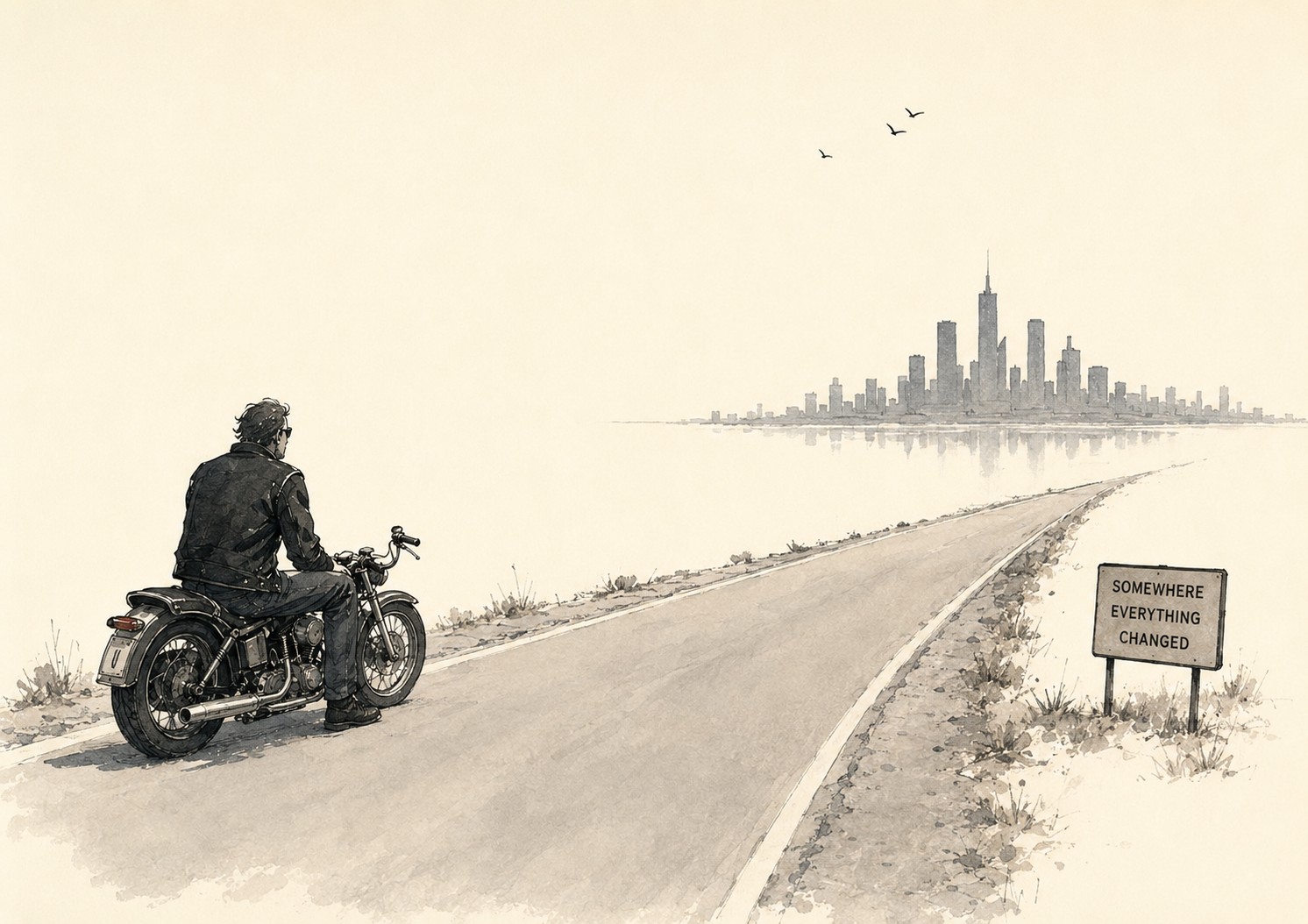
The motorcycles were never really about motorcycles. That was the first lie.
Chrome, gasoline, open highways, outlaw jackets — those were merely the last surviving symbols of a civilization that once believed a human being should own his own movement, his own mistakes, and maybe even his own soul. Turns out Wall Street found a way to securitize all three.
So, the motorcycles were never really about motorcycles. They were about owning one small piece of freedom before somebody figured out how to lease it back to you.
For years I wondered why a site like Bikernet.com bothered talking politics. Why not just carburetors, road trips, bad decisions, and desert sunsets? Why interrupt the romance with reality? Then reality interrupted everybody anyway.
Now every conversation sounds like it was focus-grouped by Silicon Valley interns who drink mushroom coffee and believe humanity can be optimized like a food-delivery app. Wall Street monetizes anxiety. Lobbyists write legislation like screenwriters pitching dystopian sequels. The media screams Left versus Right while both sides quietly shop at the same donor-funded supermarket.
Somewhere between Wall Street, Silicon Valley, and Washington, America stopped being a country and became a user agreement.
Meanwhile ordinary people are too exhausted surviving to notice they’re being harvested like subscription services. Modern civilization has achieved something extraordinary: it connected the entire planet while ensuring nobody actually talks to each other anymore. Nobody talks anymore. They upload reactions.
A coal miner in West Virginia, a biker in Arizona, a programmer in San Jose, and a single mother in Ohio all think they are enemies because somebody profitable told them so. Divide-and-conquer used to require empires and armies. Now it just requires an algorithm and a smartphone notification. And beneath all the political theatre lies the deeper terror: modern civilization increasingly punishes people for behaving like humans.
Want time to think? Unproductive. Want loyalty, family, community, craftsmanship, silence, or mechanical freedom? Inefficient. Want to fix your own engine instead of replacing your entire life every three years? Radical behavior. The internal combustion engine became dangerous the moment ordinary people understood how it worked. The internal combustion engine became symbolic because it represented personal autonomy. You could understand it. Repair it. Hear it breathe. Today’s systems are designed specifically so you cannot understand them. Coded. Encrypted. Proprietary. Even removing a sticker on a machine may void your warranty or cause a IP rights violation lawsuit. The citizen has become a permanent tenant trapped inside invisible machinery.
The average citizen spends most of life working to survive inside a system too complicated to question and too exhausting to escape. Vote someone else to deal with it. Post online to blame someone else for not dealing with it. Democracy required citizenry. A participation in decisions and formation of communities. Now it only requires a number and a button.
That is why storytelling matters now more than ever. A good story forces people to temporarily live inside another person’s suffering. It is harder to hate someone once you have inhabited their thoughts for twenty pages. Literature may be the last remaining technology capable of restoring empathy without needing Wi-Fi or Big Pharma mafia.
Maybe that is why modern society consumes content endlessly but fears genuine storytelling. Real stories slow people down long enough to notice the machine.
We once gathered around campfires to tell stories. Now we gather around algorithms designed to sell us outrage. Cavemen probably communicated better around a fire than we do surrounded by satellites, streaming platforms, and artificial intelligence. At least they looked each other in the eye before deciding who to throw rocks at.
Now we do it online, at scale, sponsored by corporations, and with free shipping.
—–Wayfarer@Bikernet.com
Associate Editor, Bikernet.com
P.S. The novella “Bizzybees” deals with understanding, not just science—do visit Amazon for considering it as your must-read book.
https://www.amazon.com/dp/B0GZFNQ934
* * *




Spot on. Excellent insight as to the state of affairs w now face.
Thanks,
–Bandit